

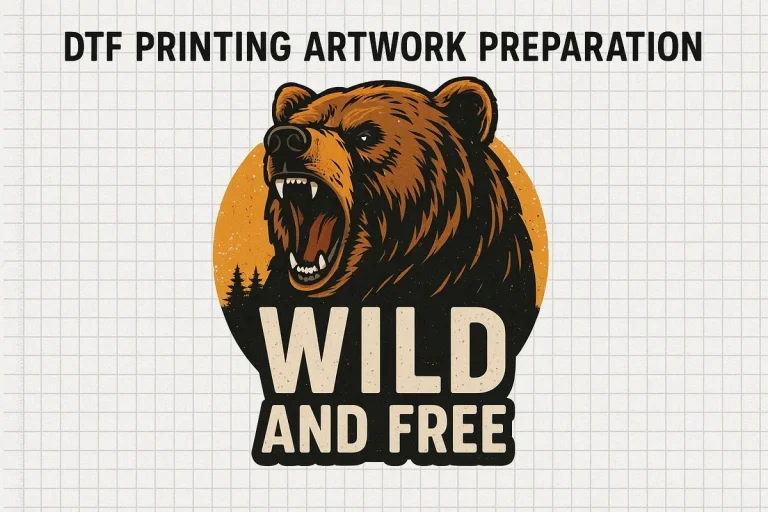
DTF Artwork Prep is the essential foundation for flawless transfers on apparel and fabrics, providing a consistent, scalable DTF printing workflow that underpins every stage of production, from design review to final inspection. Mastering this prep translates to fewer misprints, reduced color issues, and fewer reprints by starting with print-ready artwork for DTF and anticipating the constraints of the final garment, while enabling smoother batch processing and faster turnarounds. In this guide, we walk through steps that cover file setup, resolution, and color management for DTF, including how to produce a mirror image for DTF transfers so the print aligns perfectly after heat pressing, with careful attention to white underbase when needed, and a robust preflight routine to catch problems early. We also emphasize high-resolution artwork for DTF to minimize artifacts when scaled and to preserve crisp edges and legibility across different fabric weights and printing sizes, while recommending practical guidelines for raster and vector assets. By following these steps, you’ll develop a reliable DTF artwork workflow that delivers vibrant, durable results with efficiency and repeatable quality across orders, forming a repeatable template teams can reuse for new designs.
From a broader perspective, the preparation stage acts as a pre-press workflow for digital-to-fabric transfers, ensuring your artwork can be faithfully reproduced on garments. Color fidelity, file integrity, and proper resolution are the pillars that keep color from shifting and edges from fuzzy across different fabrics. Think of it as garment decoration readiness, where art is organized into clean layers, correctly sized, and compatible with the chosen transfer media. Soft-proofing, ICC profiles, and device calibration help teams predict on-textile results before committing to production, reducing waste and accelerating approval cycles. This approach aligns creative intent with manufacturing realities, enabling smoother collaboration between designers and printers.
1) DTF Artwork Prep: Laying the Groundwork for High-Quality Transfers
DTF Artwork Prep forms the foundation for high-quality transfers by ensuring every design element is prepared for production. When you invest time in proper prep, you align your artwork with the realities of the DTF printing workflow, reducing misprints and color surprises before they reach the press. This foundation helps keep batches consistent and minimizes the need for reprints, especially as you scale your DTF projects across apparel and fabrics.
In practice, this means defining the final print size, establishing bleed, and organizing layers so colors and details stay intact during transfer. By prioritizing print-ready artwork for DTF from the start, you create a repeatable process that translates digital art into vibrant, durable results on fabric, while also streamlining production for larger orders.
2) Color Management for DTF: Achieving Consistent Color Across Fabrics
Color management for DTF is critical to ensure your designs render consistently on different fabrics and between proof and final production. A color-managed workflow uses calibrated devices and ICC profiles to predict color outcomes, enabling soft-proofing that helps you anticipate shifts before you print. This approach reduces surprises on the production floor and supports reliable results across multiple substrates.
To optimize color accuracy, rely on device calibration, soft proofing, and, where available, printer ICC profiles. When you align color management with print-ready artwork for DTF, you can confidently adjust saturation, brightness, and contrast in a controlled way, ensuring the final transfer looks as intended on press and remains true to the original design across garments.
3) Mirror Image for DTF Transfers: Getting the Flip Right Every Time
Mirror imagery for transfers is a non-negotiable in most DTF workflows, because designs are applied face-down on the garment. Creating a correctly mirrored version of the entire design ensures that typography, logos, and intricate artwork appear exactly as intended after heat pressing. This step is essential to avoid misalignment and misreadable details on the finished item.
Designers should consider how text outlines and fine lines behave after mirroring. When you prepare for a mirror image for DTF transfers, you often need to add stronger outlines or adjust spacing to preserve legibility, especially for small type or dense color areas. A thoughtfully mirrored file helps maintain fidelity from screen to fabric.
4) High-Resolution Artwork for DTF: Preserving Detail at Every Size
High-resolution artwork for DTF is the key to crisp edges and clear type, particularly when enlarging designs for larger print areas. Targeting 300 PPI at the final print size is a common baseline, with higher densities (360–600 PPI) used for very detailed work—balanced against file size and workflow speed. Higher resolution minimizes artifacts and ensures smooth gradients when the image scales during transfer.
To safeguard detail, prefer vector sources where possible and keep raster assets at high resolution. This focus on high-resolution artwork for DTF supports a more robust transfer process, reduces edge jaggies, and preserves intricate textures and color transitions across a range of product sizes and fabric weights.
5) The Complete DTF Printing Workflow: From Setup to Batch Production
The complete DTF printing workflow integrates file setup, color management, mirroring, white underbase considerations, and final export. By aligning every step—from defining final print size and bleed to choosing export formats—you create a predictable path to on-demand production. This holistic view helps teams scale operations while maintaining color accuracy and alignment across orders.
In practice, this means consistent file organization, version control, and careful export settings that are compatible with your printer’s software. When the workflow is well-documented and repeatable, teams can execute large batches with confidence, knowing that the artwork remains print-ready and that color and alignment stay stable from job to job.
6) Print-Ready Artwork for DTF: Best Practices for Efficient Production
Print-ready artwork for DTF is the culmination of careful preparation. It requires clean layers, transparent backgrounds when appropriate, well-managed bleed, and export settings that match your printer’s requirements. Keeping a master working file and a clearly named final print file reduces errors during production and speeds up batch processing.
To maximize efficiency, implement a straightforward naming convention, maintain version control, and organize assets by design and size. This disciplined approach ensures that DTF Artwork Prep leads to repeatable, scalable results, enabling faster turnarounds without sacrificing color accuracy or transfer fidelity.
Frequently Asked Questions
In the DTF printing workflow, how does DTF Artwork Prep influence accuracy and efficiency?
DTF Artwork Prep anchors every print by defining final print size, bleed, color setup, and mirroring. Following a solid prep routine reduces misprints, color issues, and reprints by ensuring print-ready artwork for DTF with clean layers and properly managed backgrounds. It also streamlines production for scalable apparel projects.
What makes print-ready artwork for DTF part of DTF Artwork Prep, and how can you ensure files are ready to print?
Print-ready artwork for DTF means clean layers, transparent or correctly managed backgrounds, correct sizing, and non-destructive edits. In DTF Artwork Prep, export from master files with the right format (e.g., TIFF/PSD) and naming, so no last-minute edits are needed at print time.
How does color management for DTF work during DTF Artwork Prep to predict fabric output and minimize color shifts?
Color management for DTF starts with calibrated displays and ICC profiles. In DTF Artwork Prep, soft-proof designs, convert RGB to CMYK when exporting, and use printer profiles to predict how colors render on fabric. Test prints help confirm color accuracy before full runs.
Why is mirroring important in DTF transfers, and how should DTF Artwork Prep handle mirror images?
Mirroring is essential because DTF transfers apply face-down. DTF Artwork Prep requires creating a mirrored version of the design so it appears correctly after heat pressing. In DTF Artwork Prep, include outlines or masks as needed to preserve color integrity and readability.
What resolution targets should you aim for in DTF Artwork Prep to ensure high-quality transfers?
In DTF Artwork Prep, aim for high-resolution artwork for DTF, typically 300 PPI at the final print size. For large or detailed designs, 360–600 PPI can reduce artifacts, but balance file size and processing time. Higher resolution preserves detail when enlarged.
What common pitfalls should you avoid in DTF Artwork Prep to minimize misprints and color issues?
In DTF Artwork Prep, common pitfalls include over-saturation, underestimating white ink underbase, fabric variability, rushed exports, and inconsistent naming. Mitigate them with soft-proofing, test prints on representative fabrics, and a clear version-controlled workflow.
| Key Point | Description |
|---|---|
| DTF Artwork Prep definition | Foundation for high-quality transfers; reduces misprints; step-by-step workflow including file setup, color management, resolution, mirroring, and best practices. |
| Why it matters | Translates digital art into physical prints with precision, minimizing misalignment and color shifts when properly prepared. |
| Step 1: Define final print size and bleed | Determine the print area; add bleed (typical 0.125 in / 3 mm); follow printer guidelines. |
| Step 2: Color mode and resolution | Use CMYK; target 300 PPI; for very large or detailed designs consider 360–600 PPI; export with color accuracy in mind. |
| Step 3: Prepare image and layers | Organize layers, use non-destructive edits, clean up stray pixels; decide on background transparency or solid color. |
| Step 4: Color management and soft proofing | Calibrate monitor; apply ICC profiles; soft-proof against fabric mockups; use test prints if profiles aren’t available. |
| Step 5: Mirroring and white underbase | Create a mirrored design for face-down application; plan white underbase and outlines to preserve color integrity after mirroring. |
| Step 6: Bleed, safe area, and alignment guides | Include safe area; ensure alignment with underbase; prevent important elements from near edges. |
| Step 7: File format, export & organization | Save master working files (TIFF/PSD); export final prints (PNG with transparency or TIFF); use clear naming for batches. |
| Step 8: Test print and adjust | Run a test print on a representative garment; compare to proof; revisit steps 2–4 if adjustments are needed. |
| Step 9: Documentation and version control | Document settings and export profiles; implement simple versioning (design_v1, design_v2) to track changes. |
| Common pitfalls to avoid | Over-saturation/color clipping; underestimating white ink; ignoring fabric variability; rushed exports; inconsistent naming/organization. |
| Tools, resources, and workflows | Design software with robust export options; access to ICC profiles; color management/calibration tools; reliable test-substrate program. |
Summary
DTF Artwork Prep lays the foundation for consistent, high-quality transfers across apparel and fabrics. By investing time in proper artwork preparation, you reduce misprints, color shifts, and reprints while ensuring efficient production. This descriptive guide outlines a practical workflow—from defining final print size and bleed through color management, mirroring, and high-resolution output—to deliver vibrant, durable transfers that print accurately on demand. Adopting a solid prep routine helps accommodate different substrates and garment colors, minimizing surprises on the production floor. Key considerations include appropriate file formats, clear naming, and documentation to reproduce successful results. With careful DTF Artwork Prep, your printing process becomes scalable, repeatable, and profitable, capable of meeting growing demand without sacrificing quality. If you’re ready to optimize your workflow, start with simple designs, apply these prep steps, and gradually scale to larger batches, tracking outcomes to continually refine the process.